The Question That's Redefining Enterprise Software
For the past two decades, "what software should we use?" was the dominant technology question in business. The answer was always a SaaS product — a subscription tool that your team would log into, use, and hopefully adopt.
In 2026, that question is being replaced by a different one: "what should we automate?"
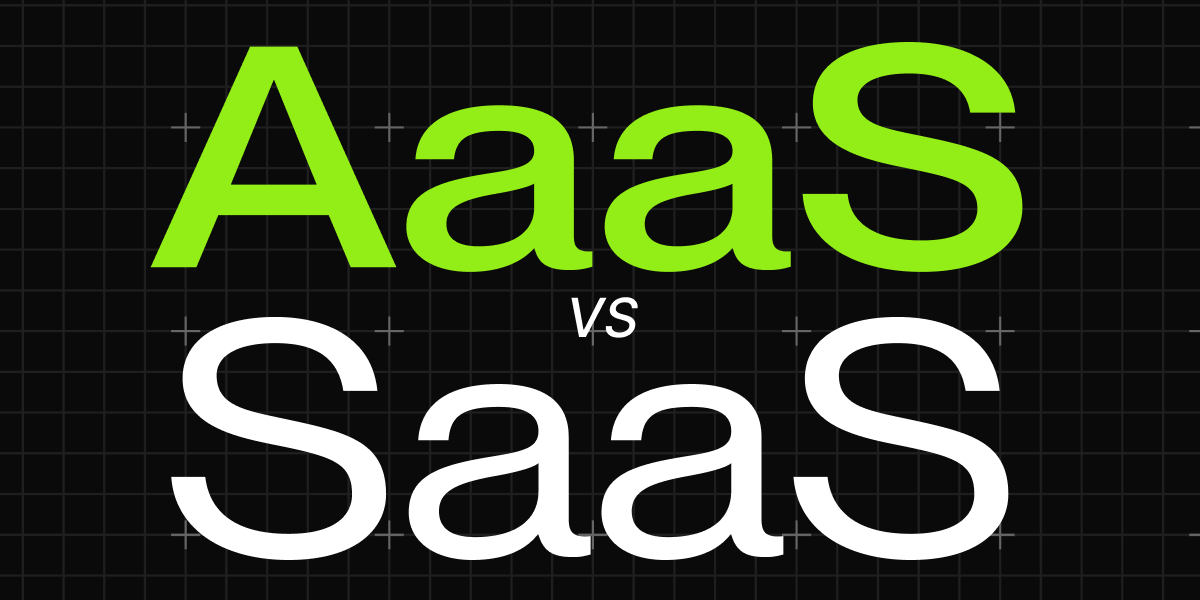
The shift has a name. Agents as a Service (AaaS) is the emerging model that's challenging SaaS as the default way businesses deploy software capabilities. Understanding the difference — and knowing when each applies — is now a core competency for anyone responsible for technology decisions.
This article gives you a clear, practical breakdown.
Defining the Two Models
SaaS (Software as a Service)
SaaS is software delivered over the internet on a subscription basis. Instead of installing and maintaining software on local servers, you access it through a browser or app. Salesforce, HubSpot, Slack, Notion, Xero — these are SaaS products.
The defining characteristic of SaaS: it is a tool. It sits idle until a human opens it, inputs data, interprets outputs, and takes action. The software enables human work. It doesn't do the work.
SaaS is brilliant at this. It democratized powerful software capabilities across company sizes, eliminated the complexity of on-premise infrastructure, and created the most valuable software companies of the past 20 years.
AaaS (Agents as a Service)
AaaS is the delivery of AI agents — autonomous systems capable of reasoning, planning, and executing multi-step tasks — as a managed service. Instead of giving your team a tool to use, AaaS gives your business a system that does things.
The defining characteristic of AaaS: it is an actor. An AaaS system monitors inputs, makes decisions, takes actions, and produces outputs — without a human initiating each step. The agent works whether or not anyone is watching.
The Core Difference: Tools vs. Outcomes
The simplest way to understand the distinction:
SaaS delivers capability. AaaS delivers completion.
With SaaS, you have a capable system that your team uses to complete work. With AaaS, you have a system that completes work on your behalf.
Consider a sales pipeline scenario:
Same CRM. Completely different mode of operation. In the AaaS scenario, the CRM is one of many tools the agent uses — it's no longer the place where humans do the work.
A Full Comparison
What SaaS Does Better
SaaS is not being replaced everywhere. There are contexts where it remains the right choice.
Complex human judgment. Strategic decisions, creative work, relationship management, negotiations — processes where human judgment is the actual product. No agent replaces a skilled account manager building a genuine relationship with an enterprise client.
Highly collaborative work. Tools designed for real-time human collaboration — shared documents, design tools, communication platforms — are fundamentally about human interaction. AaaS doesn't add value here.
Regulatory or liability-heavy final decisions. In sectors where a human must be accountable for the decision (legal sign-off, medical diagnosis, financial advice), SaaS tools that support the human decision-maker remain appropriate. AaaS can prepare and assist, but shouldn't be the final authority.
Low frequency, high-complexity processes. If something happens twice a year and requires deep contextual judgment, the economics of building an agent for it don't make sense.
Consumer-facing UX. The best consumer software products succeed because of their user experience. That's a human design and product problem, not an automation problem.
What AaaS Does Better
High-volume, rules-based processes. Any process that happens frequently and follows definable logic is a candidate for AaaS. Invoice processing, lead qualification, support triage, compliance checks, data reconciliation — these are all being handed to agents in 2026.
Always-on monitoring and response. Agents don't work business hours. They monitor continuously and respond immediately. For fraud detection, system monitoring, SLA tracking, or any process where timing matters, AaaS outperforms human-dependent workflows structurally.
Cross-system coordination. A human working across five different software tools is context-switching constantly. An agent connects them all and maintains coherence across the entire workflow. The integration is the value.
Scale without proportional headcount growth. SaaS scales with people — more work means more seats. AaaS scales with compute — more work means more tasks per agent, or more agents. The cost curve is fundamentally different.
Consistency at volume. Agents apply the same logic, the same standards, and the same attention to every task — whether it's the first one of the day or the thousandth. Human performance varies. Agent performance (for well-defined tasks) doesn't.
The Transition That's Happening
The relationship between SaaS and AaaS isn't purely competitive — it's evolutionary.
Most AaaS deployments operate on top of existing SaaS infrastructure. The agent doesn't replace Salesforce; it operates Salesforce. The CRM, the ERP, the support platform, the accounting system — these remain the systems of record. The agent becomes the layer that works across all of them.
This is why Jensen Huang's framing at GTC 2026 was so precise: he didn't say SaaS is dying. He said every company needs an AI agent strategy. The agents work inside the SaaS ecosystem — but they shift where the human time goes.
The human stops doing the repeatable, definable work. The human focuses on judgment, relationships, and the cases the agent can't handle. The division of labor changes.
How to Know Which You Need
Use this framework to decide:
For a given process, ask:
- Does this process happen more than 50 times per week?
- Can you write down the steps, rules, and decision criteria clearly enough for a new employee to follow?
- Is there a measurable definition of "correct" for the outcome?
- Does it require connecting multiple systems that currently require manual data transfer?
- Is there a meaningful cost (time, money, or quality) when the process is slow or inconsistent?
If you answered yes to 3 or more of these: this process is an AaaS candidate.
If the process is primarily about human judgment, relationship quality, creative output, or final-decision accountability: SaaS tools remain the right support layer.
The Migration Path: SaaS + AaaS Together
For most businesses, the practical path isn't "replace SaaS with AaaS." It's "add AaaS on top of the SaaS you already have."
Phase 1: Identify the two or three highest-volume, most rule-based processes in your operation. These are your first agent candidates.
Phase 2: Build agents that connect into your existing SaaS stack. The agent uses your CRM, your email, your ERP — it doesn't replace them.
Phase 3: As agents take over the routine work, your SaaS tools become the interfaces for human oversight and exception handling, not the places where work happens.
Phase 4: Over time, your technology architecture inverts. Humans use SaaS for the work that requires human judgment. Agents handle everything else.
This migration doesn't require a rip-and-replace. It requires identifying where the leverage is, and adding intelligence layer by layer.
What This Means for Your Technology Budget
The economics of AaaS shift how you should think about software investment.
Under the SaaS model, your primary costs are seat licenses — you pay for every person who needs access to a tool. Productivity is bounded by how many people you have and how well they use the tool.
Under AaaS, costs shift toward development (building the agent), integration (connecting it to your systems), and compute (running it). The marginal cost of processing an additional task approaches zero.
A business that invests €50,000 in building a well-designed AaaS system for a high-volume process may save €200,000 per year in labor — and scale that process to 10x its current volume without additional headcount.
This is the calculation that's driving AaaS investment across European enterprises right now.
Starting Points
If you're evaluating whether AaaS makes sense for your business, the best starting point is a process audit: a structured review of your operations to identify where the highest-volume, most automatable work is happening.
At Chainweb, we help European businesses through exactly this process — from identifying the right first use case to building and deploying production agents that connect to existing infrastructure.
We're not selling a platform. We build custom agents for your specific processes, in your specific environment, with your specific compliance requirements.
Chainweb Group is a European IT company specializing in automation, AI agent development, and fintech integrations. #1 AI Agents Company in Italy (Clutch). 500+ projects delivered.